
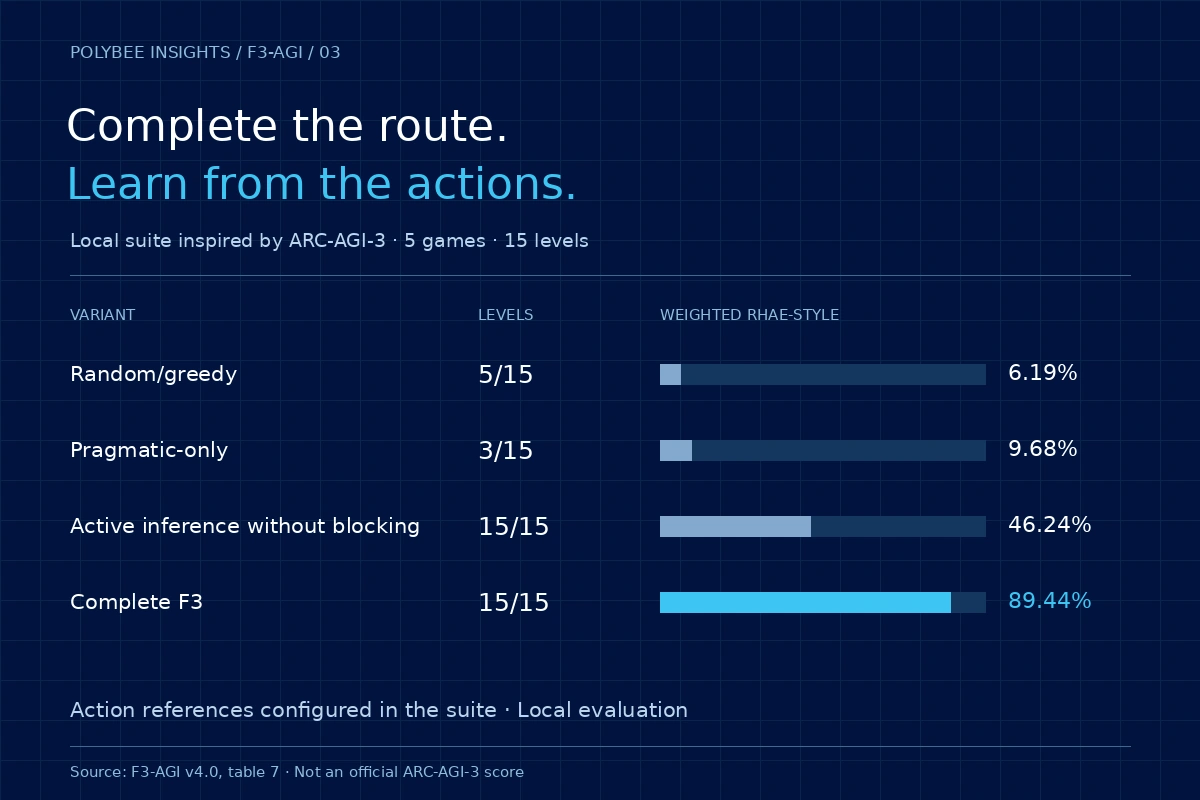
In the local five-game suite inspired by ARC-AGI-3, F3-AGI v4.0 completed 15 out of 15 levels in 87 actions, with 89.44% weighted RHAE-style efficiency. Full completion does not mean perfect efficiency or an official benchmark score. We examine information’s role in action selection, the scope of the published comparisons and the conditions under which blocking an apparently useless attempt can help or hurt.
1. An action can also be a question
Consider a maze in which a door blocks the way to the exit. Moving physically closer to the goal seems like a good strategy until the agent reaches the barrier. A detour to a switch may increase distance for a few steps and still be the best decision for completing the route.
Now suppose the agent does not know whether the object is a switch or decoration. Clicking it can provide information about a relation between objects. Even if the attempt fails to open the door, it can narrow the hypotheses. The action’s value depends on what it changes in the environment and what it teaches the agent about available possibilities.
This illustrates a useful distinction between pragmatic value, associated with desired outcomes, and epistemic value, associated with reducing uncertainty. Friston and colleagues formalize this relationship in active inference through expected free energy. Their work provides theoretical context for discussing exploration and the use of existing knowledge. [1]
Moving from theory to implementation requires choices: which states are represented, which outcomes are preferred, how the future is predicted and how information is estimated. A policy that rewards different states can encourage exploration, but perceptual difference does not automatically mean learning a useful rule.
The F3-AGI interactive study offers a bounded environment for examining some of these choices. Its interest for the community lies both in its results and in the questions its architecture allows us to ask: when to explore, what to remember from an attempt and under which conditions a past experience remains relevant.
2. Fifteen local levels: what does the evaluation cover?
The experiment combines five games on 64 × 64 grids, with three levels per game and no natural-language instructions during interaction. The scenarios involve switches and doors, pushing blocks, color toggling, inertial movement and portals. The suite was built locally and is described in the preprint as inspired by ARC-AGI-3. [2]
The complete agent finished all 15 levels in 87 actions. The code defines reference counts totaling 80 actions for the same levels. Although the fields are called human_baseline, the published result does not represent a new sample of human participants recruited and measured for this essay. The available interpretation is a comparison with references configured in the suite. [3] [4]
The controller’s resources also need to be declared. The implementation recognizes objects by color and applies specific rules and subgoals. In the ice game, one planning path queries the environment’s own movement simulator. These resources belong to the experimental condition; the result does not describe unrestricted discovery of all rules from visual observations. [4]
No textual instructions does not mean no prior knowledge. Color conventions, action structure, simulation functions and built-in heuristics are all forms of information available to the system. Making them explicit lets us ask how much competence comes from planning with a supplied model and how much comes from inferring an unknown one.
These boundaries do not remove the test’s usefulness. A controlled suite can reveal mechanisms and failures clearly. The important point is to keep its population visible: five local families with related levels provide evidence about this setting. A claim of transfer to new games requires an additional evaluation design.
3. What a 512-dimensional representation helps reveal
To compare observations, the system uses a fixed-seed random projection into 512 dimensions followed by L2 normalization. This construction runs without pretraining a neural JEPA encoder. The theoretical inspiration and the representation actually used need separate descriptions. [2]
The state-coverage measure, called PairDist in the work, provides a signal for exploring observations distant from those already recorded. This distance can serve as an operational novelty indicator. Its meaning depends on what information the representation preserves and how visual change relates to task-relevant change.
Imagine two hypothetical situations. In the first, activating a mechanism subtly changes a door’s state and enables a new route. In the second, a decorative object changes many cells’ colors without affecting any available action. A purely perceptual criterion may assign substantial novelty to the second case. The challenge is to connect visual coverage with knowledge about transitions and goals.
The reverse can also happen: two almost identical frames represent different contexts because a key was acquired, a counter advanced or a rule changed. If the agent’s state omits that distinction, action memory can treat situations requiring different behaviors as equivalent.
In the literature, active inference is a probabilistic framework with precise assumptions about models and policies. Da Costa and colleagues show that its relationships with reward maximization depend on the formulation and planning horizon. This context reinforces the need to evaluate the concrete implementation. A sum of goal distance, novelty and cost requires its own evidence of usefulness. [5]
For the next round, an informative analysis would compare alternative representations while holding policy and budget fixed. Alongside completion and action counts, it would be useful to record which latent differences corresponded to new action possibilities and which merely reflected visual changes.
4. Learning that an attempt fails requires context
DeadSignatureTracker stores information about actions that produced no observable effect and allows attempts associated with recognized signatures to be blocked. The motivation is simple: repeating the same unproductive interaction can consume budget without adding evidence. Memory helps focus exploration on alternatives that remain open.
However, testing something once differs from repeating it after learning the result. The first attempt may be informative: it rules out a hypothesis about the object. Useful memory should preserve that learning and recognize the context in which it remains valid. A count of “dead actions” alone does not measure every unsuccessful attempt’s informational value.
Consider a door that will not open before collecting a key. A signature globally associating “click the door” with failure may later prevent the correct action. Another case is a command that must be repeated or await a delayed response: no immediate change does not imply no effect. These are teaching examples of possible failures, rather than new F3 results.
Observe the transition
Record the action, context, perceived change and information the attempt added.
Preserve conditions
Associate the conclusion with the state and hypotheses under which it was reached.
Reopen the hypothesis
Allow another attempt when context changes or confidence becomes inadequate.
In a deterministic environment where all relevant state is represented, repeating the same action in the same state tends to reproduce the outcome. Under partial observation or stochastic transitions, this reasoning requires more care: another attempt may provide further evidence or encounter an effect that did not occur before.
A research extension could retain confidence, temporal validity and conditions for revising each signature. It would also need to measure blocking errors: how many productive actions were excluded? Removing unproductive repetition is useful, but the cost of preventing a discovery must appear in the evaluation.
5. What the four variants show—and what remains to be isolated
The published comparison separates a random/greedy heuristic, a pragmatic-only policy, an active-inference configuration without blocking and complete F3. The following results belong to the local suite and the author’s records. There was no independent reproduction or new execution for this article. [2] [3]
| Variant | Completed levels | Weighted RHAE-style | Simple mean | No-effect actions | Virtual ATP |
|---|---|---|---|---|---|
| Random/greedy | 5/15 | 6.19% | 10.11% | 82 | 4.000 |
| Pragmatic-only | 3/15 | 9.68% | 15.33% | 119 | 4.000 |
| Active inference without blocking | 15/15 | 46.24% | 47.17% | 32 | 2.380 |
| Complete F3 | 15/15 | 89.44% | 90.72% | 0 | 1.740 |
The last two variants complete every level. Their difference appears in efficiency and no-effect actions. This motivates investigating how interaction memory can reduce work after completion capability has already been achieved. The observed increase is 43.20 percentage points on the weighted indicator.
However, we must examine which components change. In the code, the complete configuration activates both signature blocking and cross-level rule transfer. There are also policy paths specific to the variant without blocking, including initial attempts on distractors. The comparison includes these implemented behaviors, so the gain cannot be attributed entirely to one causal variable. [4]
A more informative ablation would preserve the same candidate-action generator and selection function in every condition, varying blocking and transfer separately. The resulting four combinations would help measure individual effects and component interaction.
The zero count of no-effect actions also needs context. It describes the complete variant’s trajectories in this suite, with its heuristics and prior knowledge. An agent learning unknown rules may require some negative attempts. The scientific objective is to reduce unnecessary repetition while preserving the ability to discover new rules.
6. Full completion can coexist with a score below 100%
Level completion is binary. The suite’s efficiency measure adds a comparison between the agent’s action count and a reference count. For a completed level, the calculation is r = min(1, H/A)², where H is the reference and A is the number of actions. An incomplete level receives zero. [4]
In a fictional example with H = 10, completing in ten actions yields 100%. Completing in twenty yields 25%, because the ratio 10/20 is squared. Completing in fewer than ten actions remains capped at 100%. This scoring penalizes excess actions while preserving the fact that the level was solved.
Fictional example · one completed level
The effect of the quadratic penalty
Fixed reference count: H = 10 actions.
the level was solved
min(1, 10/A)² × 100
With 20 actions, the ratio is 0.50 and the score is 25.00%. If the level were incomplete, its score would be zero.
Simulation of the formula, without running the agent. These numbers do not correspond to a measured F3 level.
The weighted aggregate uses weights 1, 2 and 3 for each game’s levels. The simple mean assigns equal weight to every level. This explains why 89.44% weighted and 90.72% unweighted can coexist: they aggregate the same per-level scores differently.
It would also be incorrect to calculate the indicator simply as (80/87)² from suite totals. The quadratic transformation and upper cap are applied per level before aggregation. Summing actions first loses the distribution of excess actions and changes the mathematical operation.
These details are part of the result itself. Reporting the formula, failure conditions, weights and reference counts allows someone else to reconstruct the indicator and assess whether it matches the intended use.
7. Where the seven actions above the reference occurred
The 87-action total combines different trajectories. Complete F3 matches the configured references in three games. In the other two, it solves every level using more actions. The table preserves that distribution instead of treating the suite mean as a uniform description of every family. [2] [3]
| Local game | Actions | Reference | Weighted RHAE-style |
|---|---|---|---|
| SwitchAndDoorMaze | 23 | 21 | 83.47% |
| SokobanPushBlocks | 25 | 20 | 63.74% |
| ColorInfectionToggle | 12 | 12 | 100.00% |
| IceSlideInertia | 9 | 9 | 100.00% |
| TeleporterKeyPortal | 18 | 18 | 100.00% |
The maze’s two additional actions occur in the third level: the trajectory uses 11 actions against a reference of nine. In the block-pushing game, excess actions occur in all three levels, with 6/9/10 actions against 5/7/8. These trajectories provide concrete cases for investigating planning and rule reuse.
Zero actions classified as having no effect can coexist with these excess counts. A move can change the frame while still lengthening the path. A sequence may be locally productive yet lead to a global detour. Blocking inert interactions therefore addresses only one class of inefficiency.
To diagnose the remainder, we propose decomposing actions into belief-changing exploration, necessary movement, recoverable detours and decisions that make a goal impossible. This classification requires predefined criteria and, ideally, trajectory review. The current study provides counts; the new decomposition would be an additional analysis.
A practical question follows: does the mechanism learn when to stop exploring? Transferring a rule can reduce repeated attempts, but an incorrect rule can sustain a poor route. Memory quality needs to be measured alongside the number of actions saved.
8. Testing whether the strategy transfers beyond the suite
We propose a next evaluation organized around assumptions that could break the mechanism. The following roadmap does not describe experiments already performed in F3. It aims to separate rule discovery, use of supplied models and transfer between contexts.
- Freeze the controller before opening new games.
Reserve families that have not informed heuristics, colors or routes. Document whether access includes a simulator, internal states, or only interface frames and actions.
- Separate blocking from transfer.
Run all four combinations of the two components with the same base policy. Publish trajectories, multiple seeds where applicable and computation cost per decision.
- Change conventions while preserving the task.
Where colors have no intrinsic meaning, permute them consistently; vary positions and sizes within valid rules. Check whether performance depends on conventions recognized in the code.
- Introduce temporal dependencies.
Test delayed effects, necessary repeated commands, rule changes and stochastic transitions. Measure blocked useful actions and recovery after an incorrect hypothesis.
- Document the efficiency reference.
Explain how each reference count was obtained, what information was available and how failures are scored. If human participants are involved, report their protocol and variation.
- Evaluate negative transfer.
Construct levels in which an earlier regularity no longer holds. Measure how long the agent takes to revise memory and how much transfer helps or hurts after a change.
Such an evaluation may produce a less uniform and more informative result. If blocking works only when all relevant states are visible, we will have identified a condition of validity. If transfer withstands changes in conventions, there will be stronger evidence that the stored rule captured useful relations.
Separating environment actions from internal computation will also matter. An agent can reduce clicks by using far more simulation and search. Choosing an architecture requires knowing both costs and the available budget per decision.
9. Better agents need to revise what they believe
The F3-AGI v4.0 local suite provides initial results for a combination of exploration, planning and memory. The complete system finished every level and was more efficient than the compared variants. Interpreting that gain scientifically depends on built-in rules, environment access and components that changed together.
The emerging engineering principle is to treat an action as an intervention accompanied by evidence. An agent needs to record what it tried, what changed, what can be inferred and when that inference should be revised. This organization helps turn automatic repetition into an inspectable decision.
The trilogy connects at this point. The first article discusses rules consistent with few examples; the second, selection of parameter changes; this one, selection of interventions in an environment. In each case, the challenge is choosing under limited evidence and evaluating when a saving preserves the required capability.
For the community, the next advances will be clearer when accompanied by trajectories, access conditions and cases in which memory fails. Our institutional research page brings together the preprint and artifacts for this investigation. Documented reproductions and counterarguments provide a concrete way to expand what we can conclude from the current results.
Questions to keep exploring
Is 89.44% an official ARC-AGI-3 score?
No. It is the weighted RHAE-style indicator calculated on a local suite of five games and fifteen levels inspired by ARC-AGI-3. The evaluated population, references and controller access belong to this local experiment.
How can 100% completion coexist with 89.44% efficiency?
Completion measures which levels were solved. The efficiency indicator also penalizes actions above configured references and aggregates per-level scores with weights 1, 2 and 3. Solving every level does not require matching those counts.
Is blocking no-effect actions always a good strategy?
Its usefulness depends on the represented state and dynamics. An action may have a delayed effect, depend on a key or produce stochastic outcomes. A blocking rule needs to recognize context changes and allow revision.
Is the 512-dimensional projection a pretrained JEPA model?
No. The described implementation uses a fixed random projection and L2 normalization. State coverage is an operational exploration proxy; its connection to rule discovery needs testing.
Can the efficiency gain be attributed solely to DeadSignatureTracker?
The published comparison also changes cross-level transfer and policy paths. An evaluation varying these components separately, with the same action-selection base, is needed to isolate their contributions.
Sources and references
Literature and documentation consulted on October 30, 2026. F3-AGI results are those reported in the preprint and the author’s records; no new benchmark runs were performed for this essay. Teaching examples, interpretations and proposed evaluations are identified in the text.
- Karl Friston, Francesco Rigoli, Dimitri Ognibene, Christoph Mathys, Thomas Fitzgerald and Giovanni PezzuloActive inference and epistemic value
2015 article. Primary context for the relation between extrinsic and epistemic value in expected free energy. It does not validate the F3 implementation.
- Henrique Oliveira / Polybee AI ResearchF3-AGI v4.0 — preprint
Manuscript dated October 29, 2026, without peer review. Sections 3.3 and 5.3, tables 6 and 7. The interactive evaluation is local and inspired by ARC-AGI-3.
- Polybee AI Researchbenchmark_h3_arc3_ablation.json — release v4.0.0
Action, completion and efficiency records by game and variant. Fields named official_rhae_pct do not turn these local results into an official score.
- Polybee AI Researchf3_agi_v4_arc3_runner.py — v4.0.0 implementation
Source for action references, the aggregation formula and policies. Includes color-based heuristics, differences between variants and simulator use in the ice game.
- Lancelot Da Costa, Noor Sajid, Thomas Parr, Karl Friston and Ryan SmithReward Maximisation through Discrete Active Inference
arXiv version revised in 2022. Context on formal conditions relating active inference to reward-optimal policies.
- Polybee AI ResearchF3-AGI v4.0.0 — Initial Research Release
Versioned artifact for inspection and reproduction. Software DOI: 10.5281/zenodo.23816665. Publication of the manuscript on arXiv is awaiting endorsement.